
Identify Who Owns a Fayette County Property
Fayette County's assessor online-services gateway puts qPublic, GIS, deeds, and tax bills in one place. Enter the situs address first. If qPublic stalls, the GIS viewer can hand you the parcel identifier, though its tax map does not certify ownership.
- Search the address and save the parcel number, property address, and owner-of-record label.
- Match acreage, subdivision, lot, block, or other description to the intended tract.
- Search the owner as grantee in the Fayette land-record index, narrowed by date, street, subdivision, and deed type.
- Compare the newest deed's grantee, date, citation, and legal description.
Copy an LLC, trust, estate, or fiduciary label exactly. Each label describes a distinct legal role. Note: Narrow any broad deed search in Fayette County before the index reaches its 1,000-record display limit.
Confirm the Fayette County Owner in the Deed Index
The Fayette land-record index accepts searches by party, address, instrument, book and page, date, and consideration. Grantor, grantee, and both-party modes are available. Street, subdivision, lot, and block fields narrow further. Run your candidate as grantee. Concentrate on conveyance types like DEED or DEED OF CORR. The land-record index page displays the controls you will use to pin down an owner.
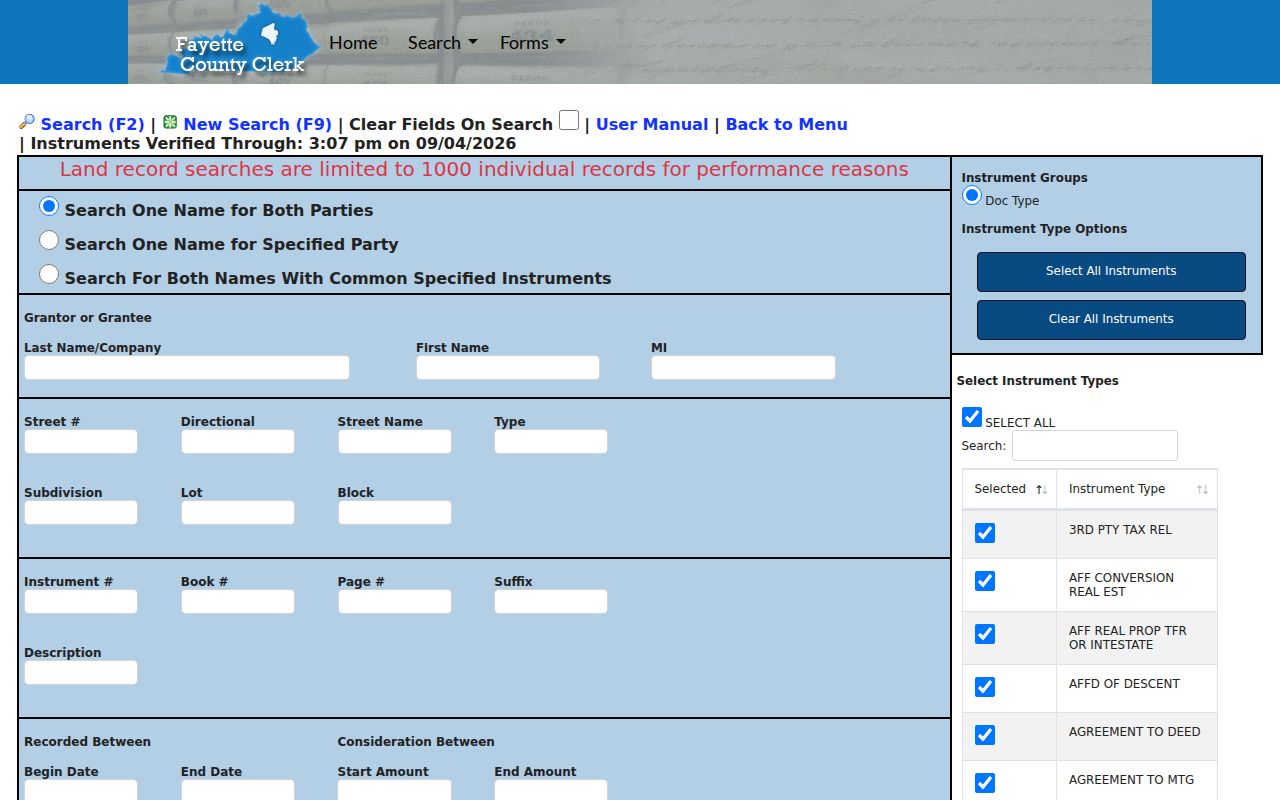
Match the legal description and recording date. When no image comes up, the Clerk's public terminal or copy route fills the gap.
Compare Fayette County Property Owner Sources
Each source answers a different part of the ownership question. The assessor supplies the administrative roll name. The Clerk indexes every recorded transfer, while GIS pins down the tract itself. Georgia's Secretary of State can identify a business entity. Its registered agent, though, is not automatically the landowner.
| Source | Owner Info It Gives | Access |
|---|---|---|
| Board of Assessors / qPublic | Roll owner, parcel ID, mailing and situs context | County-linked public portal; live controls not captured |
| Superior Court Clerk index | Recorded grantee, deed type, date, book/page and description | Online index plus counter inspection and copy routes |
| Georgia business search | Entity identity, status and agent information | Secretary of State search |
| County GIS | Parcel polygon, number, acreage, district and land lot | Public parcel service |
An assessment notice splits out owner name, full mailing address, property address, description, acreage, district, and map number. The notice keeps each field separate. The live qPublic card may show fewer fields, so compare the two records rather than assuming they match.
Read Fayette County Trust and Estate Ownership
A parcel that lists a trust or an estate should keep that exact label. Do not swap in a person's name from some other source. Pull the deed index and search the legal wording as written. Then run trustee, executor, and administrator names through it as distinct roles. Probate transfers can break a chain that first looked straightforward. The estate paperwork often settles the question.
The Fayette Probate Court file search is the place to look for wills, administrations, petitions, orders, inventories, and similar estate files. An executor or administrator deed can explain a transfer that the assessor search alone never will.
- Owner of record
- The owner label maintained for assessment.
- Grantee
- The party receiving an interest in a recorded instrument.
- Situs address
- The address assigned to the property.
- Mailing address
- The notice destination, which can be outside the county.
- Title
- The legal ownership interest, not conclusively proved by an index or tax map.
Monitor Fayette County Ownership Recordings
The Clerk offers two alert routes. Local PropertyCheck and the statewide FANS service each notify a subscriber after a matching document records. Neither prevents a filing nor judges it. The Clerk's fraud-check page explains both choices.
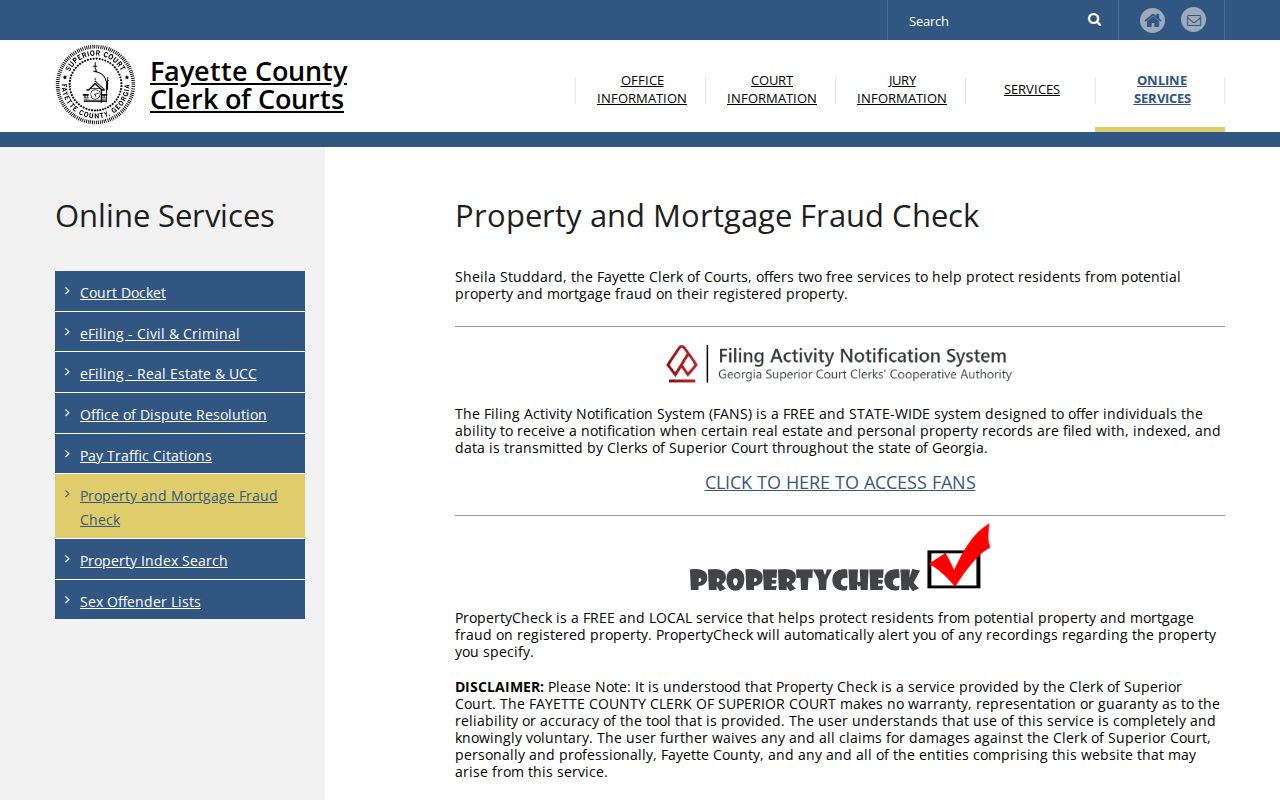
Question any alert that looks wrong. Check it against the deed index. Contact the Clerk through official channels, since a mailer's fee demand proves nothing even when it cites a real Fayette County parcel.
Handle a Recent Fayette County Sale
The assessor roll refreshes slowly after a sale. A just-recorded deed can be more current than the tax roll, so log the date of each search, the deed recording date, and the assessment notice date. When names conflict, keep both with their sources.
The current-owner guide focuses on testing the present roll entry against the latest conveyance. That test catches stale names.
Do Not Confuse Fayette County Mailing and Situs Addresses
A mailing address tells you where notices go. The situs address identifies the property itself. City and ZIP labels can mislead, especially near annexation lines and unincorporated pockets. Neither label proves municipal jurisdiction. When names or addresses repeat, the parcel number and legal description serve as tie-breakers.
The tax bill adds payment and delivery context, but paying it does not establish title. Occupancy cannot be read from a mailing address either. Stick to what each record states.
Tie the Fayette County Owner Name to the Land
A plausible name is not enough. One person or company can appear on several instruments, so pull the parcel number from GIS or qPublic first. Compare land lot, district, acreage, and plat references. The county subdivision layer tracks subdivision, phase, lot, and block along with City, Jurisdiction, FinalPlat, PlatBook, PlatPage, and Recording fields. Those fields point straight to the correct Clerk record.
Street labels change. Mailing city names can cross jurisdiction lines, and a deed's legal description may use metes and bounds rather than a modern address, so keep both forms. Stop at any ambiguity. Ask the Clerk or the Assessor which record ties the current parcel to the cited instrument.
Take a Fayette County Ownership Search Offline
Deeds, liens, and UCC filings sit at the Superior Court Clerk's office. Public terminals and supervised records access are open weekdays from 9 a.m. to 5 p.m., except holidays. An index citation may carry no image, or a historic deed may never have made it online. Go in person in those cases. A cloudy web result also justifies the trip.
Need something the office has not published? A request under the Georgia Open Records Act should spell out the parcel, the party, the document type, and the date range. Older ownership may live in index books, deed books, or the Clerk's finding aid instead. For a present-owner question, those historic volumes can still close an identity gap. Use them only for that.
Use the Fayette County Tax Bill as a Clue
The Tax Commissioner's FayetteCountyPay service offers the latest bill, E-Alerts, and an electronic mailing-address change. A bill number and mailing destination help confirm the parcel. But payment proves nothing about title. Three offices split the duties. The Tax Commissioner collects the bill, the Board of Assessors maintains the roll owner, and the Superior Court Clerk holds the recorded conveyance.
Assessor and tax records sometimes disagree on mailing information. Save both dates when they do. An electronic address change alters delivery only. The situs address and legal ownership stay untouched. If the portal lacks context, contact the Tax Commissioner at the Stonewall Administrative Complex rather than guessing the owner from the payer's name.
Save the Fayette County Ownership Evidence
A solid ownership log keeps each source separate. From the assessor, save the owner name and mailing address. Add the property address, parcel or map number, acreage, district, and description. The deed index contributes party names and roles. It also lists instrument type, recording date, and book/page or instrument number. Include consideration when shown, plus image availability. From GIS, keep the parcel identifier. Add the land-lot, subdivision, phase, and jurisdiction fields that tie the tract together.
Note the gaps too. Exact result labels on the live qPublic parcel card and deed-index screens deserve their own line in the log. The county's normal roll-update delay does as well. Recording what remains unknown beats assigning a guessed owner date.
Respect Fayette County Protected Address Records
Georgia Safe at Home launched in 2026. VoteSafe adds a separate voter-address confidentiality route. Both programs can explain why a public search omits or substitutes an address. The right response is to respect the protected record. Rebuilding the location from unrelated sources is not.
Sealed court files and lawful redactions open other gaps. Keep the ownership question tied to the parcel and the recorded interest. It should never become an effort to identify an occupant or expose protected personal details.
Know the Limits of a Fayette County Owner Lookup
A roll name answers none of the harder questions. Unrecorded interests and active encumbrances sit beyond it. Competing claims and the legal effect of an instrument sit beyond it too. The Clerk treats online index data as general information, not a guarantee. Safe at Home, VoteSafe, and sealed records are boundaries. Lawful redactions are boundaries too, not errors to work around.
Lawful use. An owner lookup can support purchase diligence, estate work, fraud monitoring, or a boundary question. Never use it to stalk, harass, intimidate, or harm anyone.
County discovery records never amount to a title opinion. Obtain recorded copies and qualified help when legal ownership must be established.