
Fayette Deed Records by Type
One index holds them all. The Clerk groups deeds with mortgages, liens, plats, releases, easements, leases, powers of attorney, wills and other land instruments, so picking the right document class keeps a Fayette County property search on target.
| Deed Type | What It Does | Common Use |
|---|---|---|
| Warranty deed | Conveys the stated interest with covenants in its text | Ordinary sale |
| Quitclaim deed | Conveys whatever interest the grantor holds | Interest cleanup or family transfer |
| Correction deed | Corrects an earlier recorded deed | Name or description correction |
| Executor or trustee deed | Conveys under stated estate or trust authority | Probate or trust transfer |
| Tax deed | Records a transfer tied to tax-sale procedure | Delinquent-tax history |
A mortgage or lien is not a deed. It records a claim or security interest against the land. A later release marks another event in that same history, so the earlier instrument stays in the chain.
Inside Fayette County Deed Index
The Clerk's live land-record index supports several angles of attack. You can run one name against both parties. Alternatively, target a single specified party. Or pair two names with selected instruments in common. Party fields take a company or last name, first name and middle initial. Property filters dig into street number, direction, name and type, subdivision, lot, block and description. If you already hold a citation, instrument number or book and page pulls it straight up. Date and consideration ranges trim oversized result sets. Searches cap at 1,000 records. The official Fayette deed index page displays the current filters and verification status on screen.
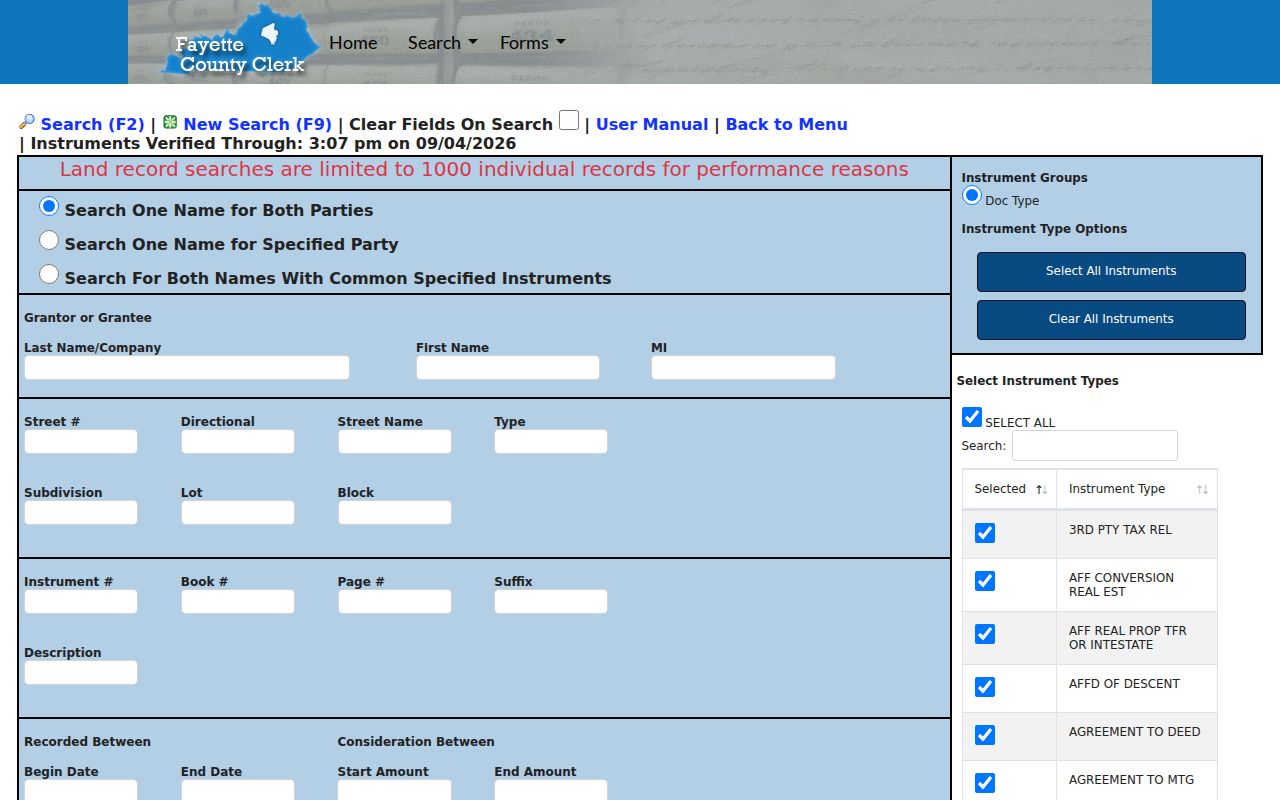
Separate grantor, grantee, street and subdivision fields beat a lone surname query. They let you tighten a chain search instead of drowning in every Fayette County name match.
Follow Fayette County Deed Chains
The grantee receives the interest. The grantor conveys it. Start from the newest supported owner of record and walk backward, matching the same tract at every link in the deed records.
- Find the latest purchase deed with the current roll owner as grantee.
- Read the grantor and exact legal description from that instrument.
- Search the grantor as an earlier grantee, then compare description, book/page and dates.
- Repeat until the online index ends, then move to Old Index Books and Clerk volumes.
- Grantor
- The party conveying an interest.
- Grantee
- The party receiving an interest.
- Chain of title
- The ordered sequence of recorded transfers for the same land.
- Book/page and instrument number
- Two citation systems used to locate a recorded document.
Old Fayette County Deed Books
The Clerk's historic finding aid maps the old paper territory. It identifies deed and mortgage index books generally covering 1794 through 1903. It also lists old deed books, surveys from the 1780s and 1817 onward, partition records, orders, wills, and property-tax series for 1807 and 1808. Its book ranges overlap and can be hard to read. Confirm any edge year with Clerk staff. The live system adds Old Index Books and routes for non-indexed documents. Search an alphabetical grantor or grantee index for a book and page. Then request that volume through the counter. Georgia Archives guidance says county-created records generally remain locally held. The linked finding aid illustrates this broader set.

When a modern Fayette deed search comes up empty, the named book series offer a practical off-ramp into the older deed records.
Probate Breaks in Fayette County Deeds
Estate papers can interrupt a clean person-to-person sequence. Fayette Probate Court files may hold administration papers, inventories, petitions to sell and heir details. They may also show authority for an executor or administrator. A later deed may name the estate, the fiduciary or the heirs as parties. Search the decedent, the estate and the executor or administrator on their own. Search likely heirs on their own too. Compare the probate file against WILL, ORDER, MISC and DEED entries in the land index. Probate authority explains why a transfer happened. The recorded deed documents the conveyance placed in the property records.
Fayette County Plats Join Deeds
Subdivision, lot and block filters tie deeds to plats. The county GIS subdivision layer adds PlaceName, Phase, City, Jurisdiction, FinalPlat, PlatBook, PlatPage and Recording fields. Treat those as discovery data. Then retrieve the recorded PLAT or CONDO PLAT from the Clerk. Peachtree City's planned villages give you useful search labels. These include Aberdeen, Braelinn, Glenloch, Kedron and Wilksmoor. Check them against the GIS city and jurisdiction fields. A familiar development name never replaces the deed's legal description.
Fayette County Deed Alerts
The Clerk offers county PropertyCheck and statewide FANS recording notifications. An alert flags a new index event tied to a name or property criteria, giving an owner a prompt to inspect the filing. It cannot stop a document from being recorded. It does not judge whether a filing is valid. The Clerk's fraud-alert page explains both routes.
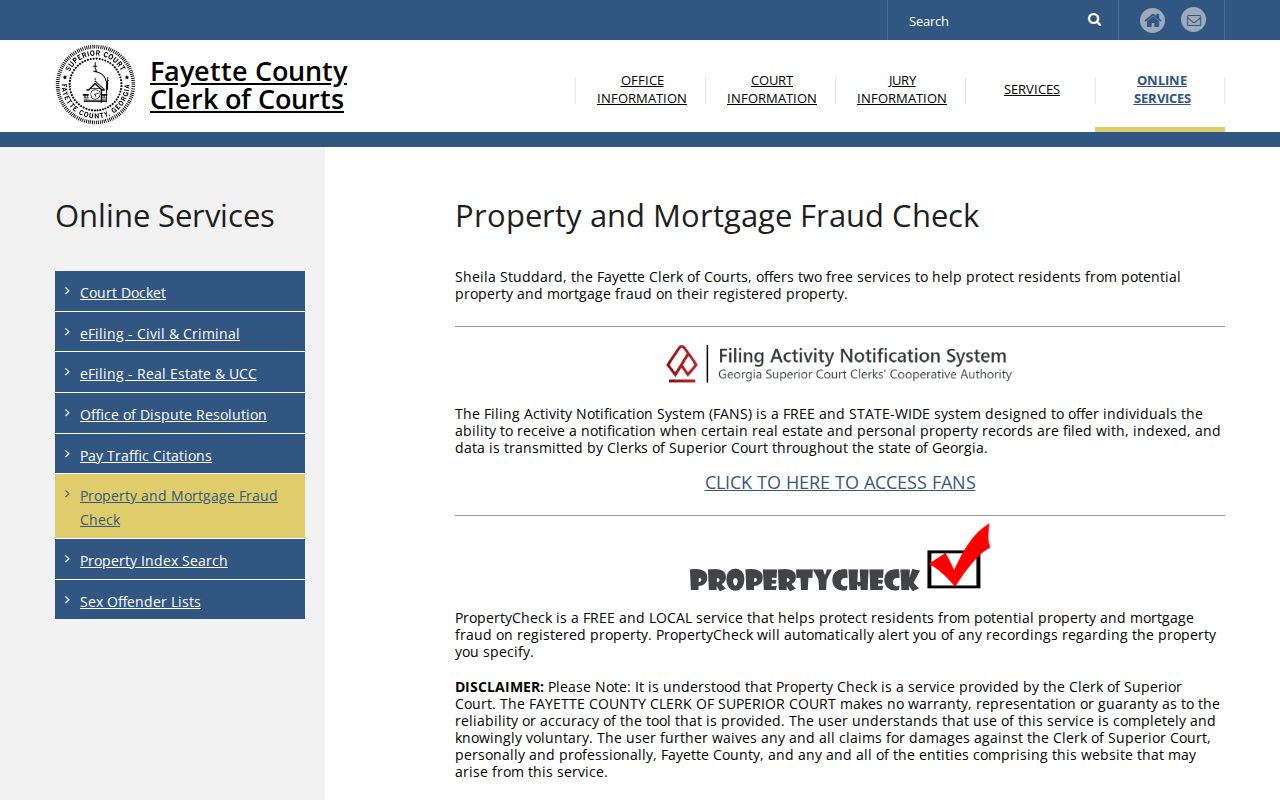
The county notice makes independent verification essential after an alert arrives.
Order Fayette County Deed Records
Start with the online image when one exists. The Clerk's public terminal shows proceedings and images more broadly than the public web index. The search policy states that deeds, liens and UCC records are open subject to legal exemptions. Public inspection runs 9 a.m. to 5 p.m. on weekdays except holidays.
The July 2024 fee schedule lists unassisted copies at $0.50 per page, assisted copies at $1 per page, and certified copies at $0.50 per page plus a $2.50 seal. Larger pages and electronic delivery carry separate charges. Confirm current fees before ordering. GSCCCA eCertification offers another certified-copy path for deed records.
Recorded, not guaranteed. Fayette County deed records show what entered the Clerk's system. They are not a title opinion, and unrecorded interests or later legal issues may exist.
Narrow Fayette County Deed Names
The land index caps results at 1,000 records. A broad surname search can hit that ceiling fast. Begin with the person or exact company name instead. When the role is known, choose grantor or grantee, and frame the transfer with a date range. Street, subdivision, lot and block fields help separate people who share a name. Instrument groups also keep mortgages, liens and unrelated filings from crowding out deed records.
| Problem | Narrow with | Confirm against |
|---|---|---|
| Common personal name | Party role, date, street | Legal description |
| Company owner | Exact legal name, instrument type | Georgia eCorp and deed party |
| Subdivision parcel | Place name, phase, lot and block | Recorded plat book and page |
| Historic transfer | Old alphabetical index | Physical deed volume |
Liens Beside Fayette Deeds
Ownership transfers and encumbrances live in the same land-record system. They are not the same record, though. The instrument list covers mortgages, assignments, releases, local liens, state and federal tax liens, mechanics liens, lis pendens, delinquent-tax releases, easements and restrictive covenants. Leases and fixture filings round out the list. Pick the right group. Then search the same parties and land description you used for the deed.
A release or satisfaction is its own later event in the deed records. Tie it to the original mortgage or lien by party, citation and dates. It does not erase the earlier filing. Lis pendens works differently. It warns of pending litigation affecting land. The related court docket holds the orders, dismissal or disposition. A deed index result also cannot tell you a debt's current balance.
Ambiguous filing? Open the document image or order a copy. Compare its legal description against the deed and parcel number. Then chase later assignments, corrections, releases and court orders. That builds an evidence trail without treating an index label as a legal conclusion.
Fayette Courthouse Record History
Fayette County dates to 1821. Fayetteville became the county seat in 1823. The county points to its 1825 courthouse as Georgia's oldest still in use. That landmark pairs with an unusually deep Clerk finding aid for property records. The aid lists old deed books, deed and mortgage indexes, surveys, land treasury warrants, partition records, county orders, guardians books, wills and early tax records.
Expect some overlap in the ranges. Deed-book groups run from the late 1700s into the twentieth century. Partial mortgage and release runs carry their own date bands. The PDF is a route to a volume, not a promise. It cannot guarantee the image is online or that every boundary date is exact. Clerk staff and the live selector should confirm the series you need.
The finding aid carries the label "burnt records." No official source establishes a Fayette courthouse fire. Nor does it name a specific loss period. Treat it as a catalog label only. A courthouse-fire story would stretch past the evidence.
Verify Each Fayette Deed Link
A reliable chain needs its own entry for every conveyance. Log the instrument number, type, recording date, book and page, every grantor and grantee, and consideration if displayed. Include the street, subdivision, lot, block, and the full description. Record image availability and the source timestamp too. Then compare the land description with the parcel card. Compare it as well with the recorded plat and the GIS feature.
The assessment owner may not match the newest deed grantee. Check the assessment notice date against the deed recording date. Recent transactions often reach the Clerk before the assessor refreshes the tax roll. A parcel split complicates things further. It creates a new identifier, while the deed still describes the older tract. Keep both values until the custodian explains the update.
Legal proof demands the instrument itself plus context. A title professional may also search judgments, probate files, federal records, court dockets, and unrecorded matters. No public index can settle those. Fayette County deed records remain the central recorded evidence. Still, no single hit adds up to a complete title opinion.