
Read Fayette County's Current Owner Record
The county's published assessment-notice sample offers the fullest field inventory. It splits owner and mailing details from the parcel address. Administrative facts sit in their own columns too. The live qPublic card can vary. So a notice field shown here may appear differently on screen.
| Owner name | The roll's present owner label, which may be a person, company, trust or estate |
|---|---|
| Complete mailing address | Where assessment notices are sent, not necessarily the property |
| Property address | The situs assigned to the parcel |
| Property ID / map number | The key used to keep the record tied to the right tract |
| Description, acreage and district | Facts used to cross-check the parcel against the deed |
| Last-sale or deed reference | Useful when displayed, but not verified on the live card in this research |
Owner of record does not mean occupant. A mailing address can sit outside Fayette County while the situs stays local. Neither fact tells you who lives there.
Find the Fayette County Owner of Record
The Board of Assessors online-services page is the gateway to the qPublic real-property search. Start with an address when the owner name is unknown. Save the parcel number and the owner spelling exactly. The county GIS parcel layer can still identify a parcel when the vendor screen is down. It cannot certify ownership, though. The Assessor's office is at 140 Stonewall Avenue West, Suite 108, Fayetteville. Call 770-305-5402. A counter or phone request is the fallback when a web result is missing or a displayed field needs context. Ask which roll or notice date the name reflects.
Separate Fayette County Mailing and Situs Fields
The official notice sample makes the split plain. A complete mailing address is where owner notices go. The property address is the situs. A postal city or ZIP does not settle municipal planning jurisdiction, especially near city boundaries and unincorporated pockets.
| Field | What it answers | What it does not answer |
|---|---|---|
| Owner name | Who the assessment roll currently labels | Who occupies the property |
| Mailing address | Where notices are sent | Where the owner resides |
| Situs | Which street address belongs to the parcel | Which city controls zoning |
| Parcel ID | Which assessment unit is being viewed | Legal title by itself |
Note: Keep mailing and situs values in separate fields. Merged fields create false owner and jurisdiction matches.
Confirm Fayette County's Current Owner Now
The Fayette land-record index finds the newest recorded conveyance. Grantor, grantee, and both-party modes are offered. Controls for date, instrument, street, subdivision, lot, block, book/page, and consideration narrow the rest.
- Save the current roll owner, parcel ID, situs, mailing address, and source date.
- Search that name as grantee and isolate the newest DEED or DEED OF CORR affecting the tract.
- Match parcel description, subdivision, lot, block, acreage, and other legal-description clues.
- If the latest recorded grantee differs, retain both names and dates and confirm the instrument through the Clerk.
- Owner of record
- The party presently named on the assessment roll.
- Assessment roll
- The administrative property list maintained for valuation and taxation.
- Recording lag
- The interval between a deed's recording and a later roll update; Fayette's typical interval was not published.
Recent sale warning. The roll can lag a closing. When a newer recorded deed matches the tract, its grantee is the more current recorded ownership lead.
Use the Fayette County Deed Timestamp
The Fayette land-record index displays the current-owner confirmation interface along with a processing cutoff. It showed instruments verified through 3:07 p.m. on September 4, 2026. That cutoff is a progress marker. It is not a coverage guarantee. Save the timestamp shown whenever you search.
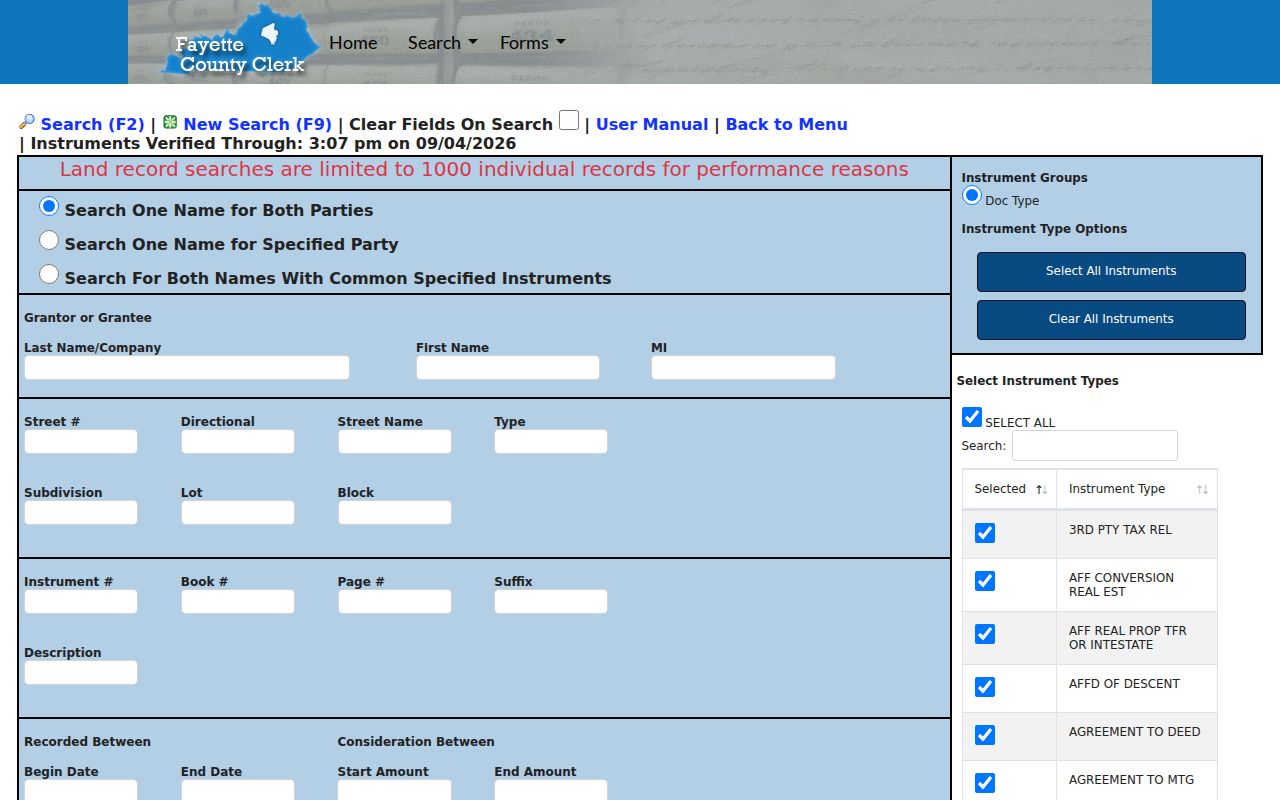
The index caps any search at 1,000 records. Narrow a common grantee name with date, deed type, street, or subdivision filters. A broad search that returns nothing proves little.
Verify a Fayette County Entity Owner
An LLC, trust, estate, trustee, executor, or administrator can be the exact owner label. Never swap it for a person's name. Georgia's Secretary of State business search accepts name, control number, registered agent, officer, or designated-agent queries. Entity status and agent data help you find the right company. An agent is not automatically the owner. A trust may lack a public entity registration. Search the grantee label and the trustee name as separate deed-index leads. Estates differ again. The Probate Court file route can explain that authority behind an executor or administrator deed.
Keep Fayette County Sale Data in Context
The assessor notice may carry value history. A parcel card may show last-sale information where that field exists. The deed index adds a separate consideration search. Neither a nominal consideration nor a family or estate transfer should be read as a market sale. The Assessor excludes foreclosure, relative, adjacent-owner, and other non-market sales from its residential study. Report the recorded party and date only.
Verify Fayette County Current Owners at the Counter
When the assessor portal is unavailable, call or visit the Board of Assessors with the exact address and parcel ID. The deed index may lack images. Turn to the Superior Court Clerk's supervised file or public terminal instead. Supervised files and a public terminal are available there. The Clerk's posted inspection hours run 9 a.m. to 5 p.m., Monday through Friday, except holidays. Ask by parcel, grantee, document type, and date range. Distinguish inspection from a certified copy. Certification may matter for a legal filing, while a screen print usually keeps a lead moving.
Watch New Fayette County Owner Filings
The Clerk's PropertyCheck and FANS page describes notification tools for new recordings. Alerts cover new deed and mortgage filings. An alert prompts a fresh current-owner check. It neither blocks the filing nor certifies its validity. Compare any alert against the land index, confirm the parcel description matches, and contact the Clerk through an official route if the filing seems unfamiliar. Real numbers do not make a solicitation official.
Date Every Fayette County Current Owner Source
Freshness has a date attached. The assessor's notice carries a valuation date. Every deed carries a recording date. A live index shows its own timestamp. Put those dates next to each owner name. That way nothing reads newer than it is. A sale that closed after January 1 can leave the assessment roll and the deed pointing at two different owners on paper. That is normal rather than a conflict.
Dating each source also keeps a screenshot from hardening into fact. If the deed is recent, run the deed search again before relying on the name. Ask the Assessor which roll date the displayed owner reflects.
Check the Fayette County Current Owner Record
A short evidence log pays for itself later. Record the normalized address, the parcel number, the tax roll owner, mailing and situs entries, the source date, the newest deed type, grantee, recording date, book and page or instrument number, and matching legal description terms. Jot down anything missing, such as an image that would not load.
Suppose the online index gives a citation but no image. The Superior Court Clerk permits public inspection through supervised files and terminals, 9 a.m. to 5 p.m., Monday through Friday except holidays. Certified copies exist for situations where legal reliance demands more than an index line.
Respect Fayette County Owner Record Limits
The mailing field serves notice, nothing more. It does not confirm where anyone lives or sleeps. Safe at Home and VoteSafe protections, sealed files, and lawful redactions can mask or replace an address. Treat that absence as a privacy line. Do not rebuild a protected address from unrelated records.
Lawful use. Current-owner records may support a purchase, estate, fraud-alert, or boundary inquiry. Never use owner information to stalk, harass, intimidate, or harm anyone.
Use the assessor and GIS maps to find property. The Clerk's online index comes with no guarantee. Where legal ownership truly matters, verify the recorded deed itself and bring in qualified title help.