
Read Fayette County Property Tax Records
In Fayette County, two offices divide the work. The Board of Assessors values both real and personal property. The Tax Commissioner builds the collection record from those figures. A mailed assessment notice carries identity, administrative, and value fields in one place. The public qPublic parcel card does not always show every notice field. Note which document each detail came from.
| Field | What It Shows | Where |
|---|---|---|
| Owner and property ID | Mailing address, situs, description, acreage and map number | Assessment notice or qPublic when shown |
| Fair market value | Return, previous, current and other 100% value columns | Board of Assessors notice |
| Assessed value | Georgia's 40% assessment columns and conservation-use value | Board of Assessors notice |
| Exemption and covenant | Homestead status, covenant year and taxable context | Assessment record |
| Bill and payment route | Most-current bill, E-Alerts and address-change options | FayetteCountyPay |
Assessed value is the tax base. It is not a forecast of what a buyer will pay. A deed's consideration and a recent arm's-length sale answer a different question than an annual appraisal, and the Fayette County property value guide sorts out those figures.
Separate Fayette County Assessment From Collection
Fayette County splits the work behind every property tax bill. The Board of Assessors sets values. It also keeps the parcel characteristics in the county property records. The office handles exemption applications and assessment appeals. You will find it in Suite 108 at 140 Stonewall Avenue West, Fayetteville. The phone number is 770-305-5402. It never mails the bill itself.
Collection belongs to a separate office. The Tax Commissioner's service issues each Fayette County tax bill and takes the payments. Its office sits in Suite 110 of the same complex. It operates Monday through Friday from 8 a.m. to 5 p.m. The number there is 770-461-3652. The online property search also supports payment, E-Alerts, and electronic mailing-address changes. So the official tax portal is the place to begin on the collection side.
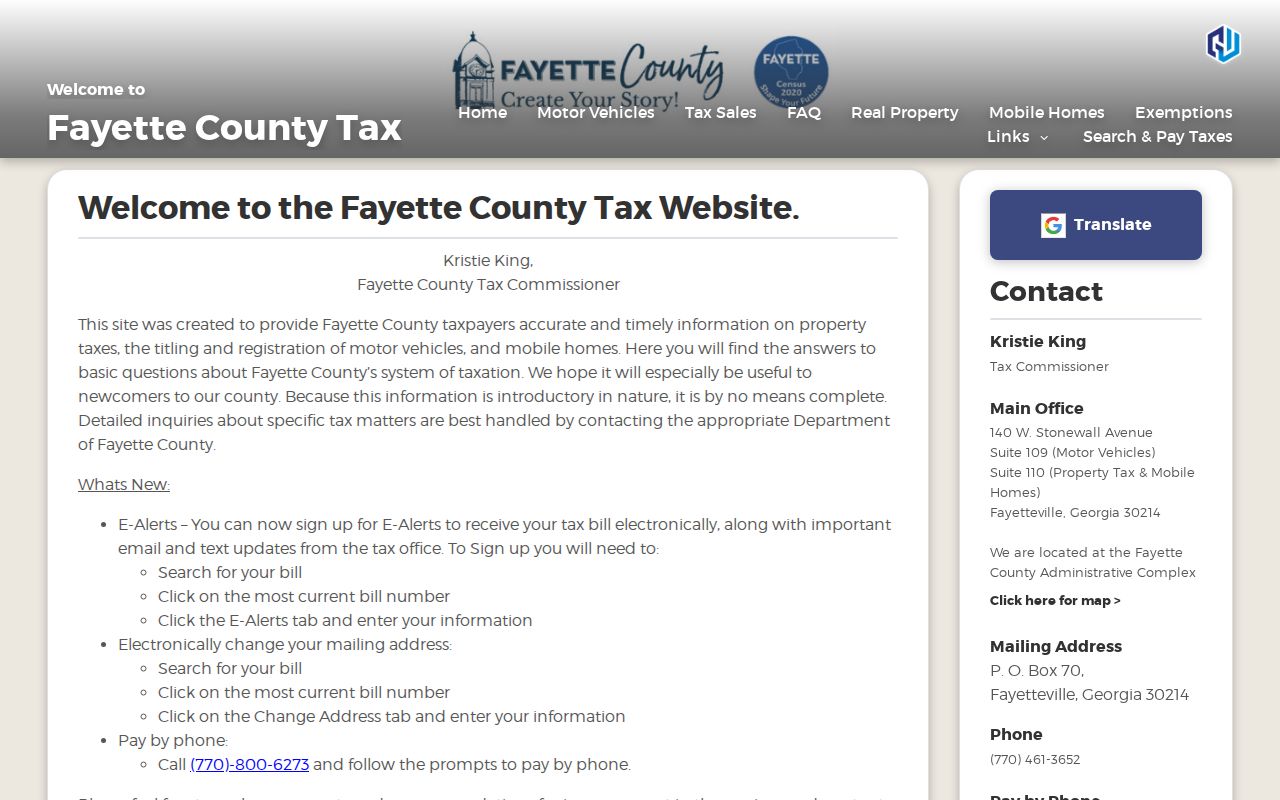
The tax screen belongs to the Tax Commissioner's workflow, while value disputes still go to the Board of Assessors.
Interpret the Fayette County Assessment Notice
A Fayette County assessment notice separates the owner and mailing address from the property address. That split matters. It keeps a mailing destination from being mistaken for the land's actual location. The notice also lists the notice date, last appeal date, property ID or map number, acreage, tax district, covenant year, homestead status, property description, reasons for the change, and an estimated ad valorem bill.
- Fair market value
- The assessor's estimate of full value as of the annual valuation date.
- Assessed value
- The assessment base shown at 40% under Georgia's system before applicable adjustments.
- Millage or levy
- The rate applied by taxing authorities to the taxable base.
- Homestead exemption
- Qualified relief tied to ownership and full-time occupancy.
- Tax lien
- A claim arising from unpaid property tax, separate from the original value decision.
Residential appraisal staff reports researching roughly 3,000 sales each year. The team screens out foreclosure, relative, adjacent-owner, and other non-market sales, and it weighs zoning, deed restrictions, and use before treating a sale as evidence of value.
Look Up a Fayette County Tax Bill
Begin with the most-current bill advertised on FayetteCountyPay. Field labels on the public search are not uniform, and historic coverage is not guaranteed. Confirm what the official pages actually offer before counting on a particular search field or an older tax record.
- Resolve the parcel ID and situs address through the county-linked qPublic search or GIS.
- Open the most-current bill in FayetteCountyPay and save its bill number, year, amount and displayed status.
- Compare exemptions and value on the assessment record rather than inferring them from the payment screen.
- For delinquency or sale, confirm the live list, date, redemption terms and payment rules with the Tax Commissioner.
Changing a mailing address on the bill does not change title, situs, or assessor ownership evidence. If the portal cannot find the bill, call or visit the office directly.
Fayette County Exemptions Begin With the Right Form
The assessor forms page gathers every Fayette County filing in one spot. Options include homestead, homestead removal, conservation use, and law-enforcement nondisclosure forms. Address change, appeal, sales request, and personal-property forms round out the list. Basic homestead has three requirements. You must own the property. You must occupy it full time on January 1. You must also hold a current Georgia driver license or ID showing that address. Conservation use can cover up to 2,000 acres under a 10-year covenant. Tracts under 10 acres need extra support, and breaking the covenant can trigger a penalty. A tax screen alone never establishes eligibility. Note: Confirm the current filing window and required proof with the assessor before using an older saved form.
Request Fayette County Sales Evidence
For appeal evidence, the assessor's 2023 sample sales-study request form asks for the parcel ID, owner, property address, requester contact and mailing details, delivery method, signature, and date. The standard study includes the property record card and comparable sales. It takes 7 to 10 business days. It listed extra sales at $0.10 per page.
The form states plainly that it is not an appeal. Treat it as a way to gather evidence. Then follow the current appeal procedure and your individual notice deadline. Confirm current charges and the current form before submission.
Connect Fayette County Field Cards to Value
Fayette County residential appraisal work goes well beyond sale prices. The assessor's field-card material includes structural notes, a floor-plan sketch, exterior measurements, and a photograph. Staff also researches zoning, deed restrictions, and use. Those details often explain why two nearby parcels carry different fair market values. Their street addresses may look alike. Challenging a value takes specifics. Name the characteristic you believe is wrong and attach a source for the correction. A survey, recorded plat, permit record, or clear measurement beats a broad claim. Nearby tax bills being lower is too broad a claim. Save the property record card that comes with a sales study. Then mark each disputed field on it.
Use Fayette County Property Tax Fallback Channels
A portal outage does not end the search. The Tax Commissioner takes office and phone inquiries, and lists a separate pay-by-phone number, 770-800-6273. The Board of Assessors can explain roll, notice, exemption, and value fields. When a record is not published, file a focused request under the Georgia Open Records Act. Name the parcel ID, address, record type, and date range.
Keep the custodian split straight. The Tax Commissioner does not set assessments. The Assessor does not confirm payment status. Send each question to the right Fayette County office. For old bills or historic online depth, ask the custodian directly and record the response date.
Choose the Fayette County Appeal Route
Fayette County offers three appeal routes. They are not interchangeable. The Board of Equalization costs nothing unless an agent is used. The hearing-officer path covers only specified non-homestead real or contiguous property, or wireless personal property, above $500,000. Arbitration demands more: a certified appraisal prepared within nine months before January 1, a $25 Superior Court Clerk filing fee, and possible arbitrator costs.
Put the essentials in writing. State the parcel or map number, the grounds, the taxpayer's opinion of value, the selected route, and a signature and date. Keep proof that the appeal was received. Value disputes call for comparing the assessor's property characteristics against sales evidence. Exemption and taxability disputes are different. Name the real issue rather than treating every disagreement as a valuation error.
Track the Fayette County Valuation Date
The Assessor's appeal page says property is valued as of January 1 each year. That fixed valuation date explains why a later improvement, demolition, or sale may not line up neatly with the current assessment record. Record the notice year, valuation date, appeal date, and the date of every sale or physical change used as evidence.
The county separately scheduled 2026 personal-property notices for July 28, after the reported June mailing for residential and commercial notices. Do not transfer a date from one property class to another. Use the notice for the specific account and ask the Assessor to resolve any conflict before the 45-day window closes.
Preserve the reason for change printed on the notice as well as the prior and current value columns. That record helps distinguish a broad annual valuation change from a parcel-specific correction, exemption change, covenant issue, or newly captured improvement. The estimated ad valorem amount on the notice is context, while the Tax Commissioner's current bill remains the collection record.
Trace Fayette County Delinquency and Tax Sales
Start with the Tax Commissioner tax-sale page. The Tax Commissioner posts Fayette County's sale dates and parcel lists there. Sheriff's court-sales records can surface related tax deeds and liens. The Clerk's deed index can surface releases and notices. The official tax-sale page also carries the county contact route. Neither the Sheriff nor the Clerk substitutes for its live sale terms.
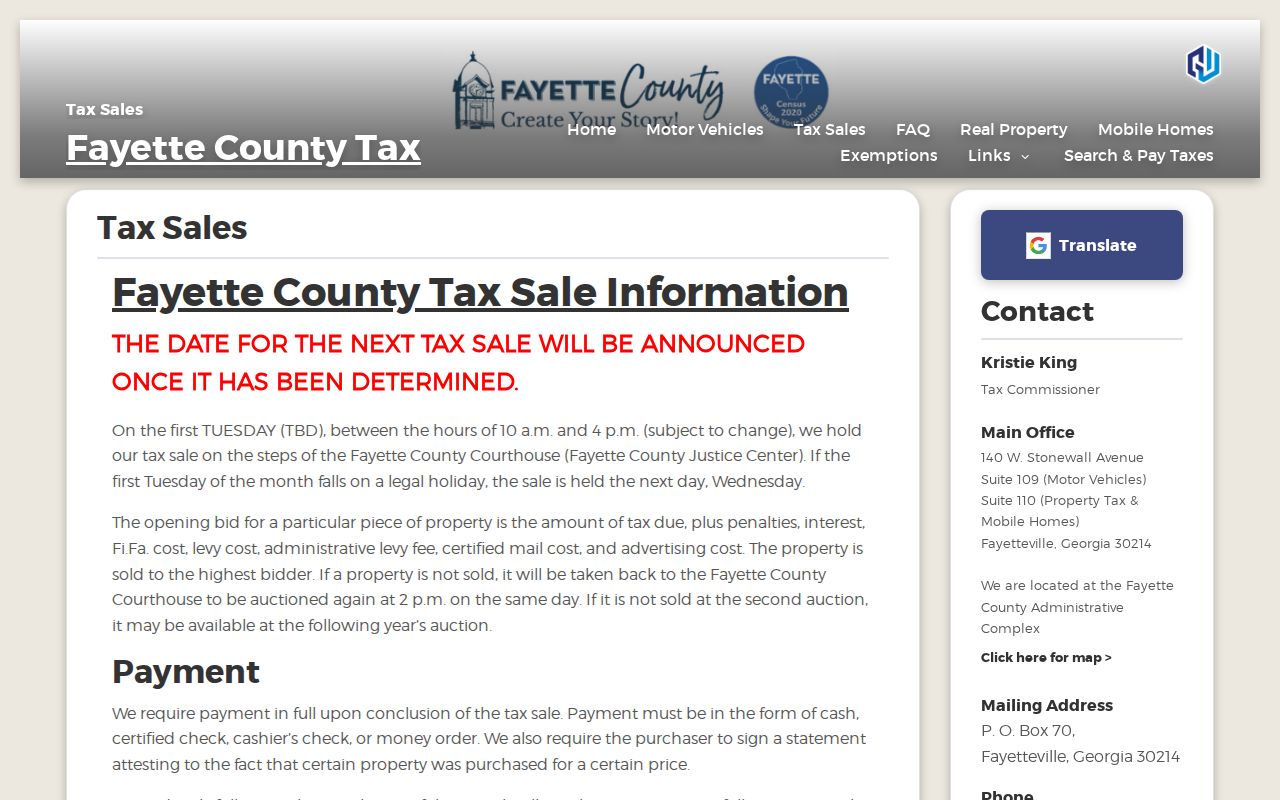
Verify the sale date, parcel list, required funds, and redemption terms directly with the Tax Commissioner before relying on any archived Fayette County tax-sale notice.
Contest a Fayette County Assessment Carefully
The county appeal page sets the rules. Appeals must be written and received within 45 days. Each one identifies the parcel or map number, the grounds, the taxpayer's opinion of value, the selected route, and a signature and date. Three routes exist. Fayette County taxpayers can choose the Board of Equalization, a hearing officer for qualifying cases, or arbitration, and the official appeal page details each route's appraisal and cost requirements.
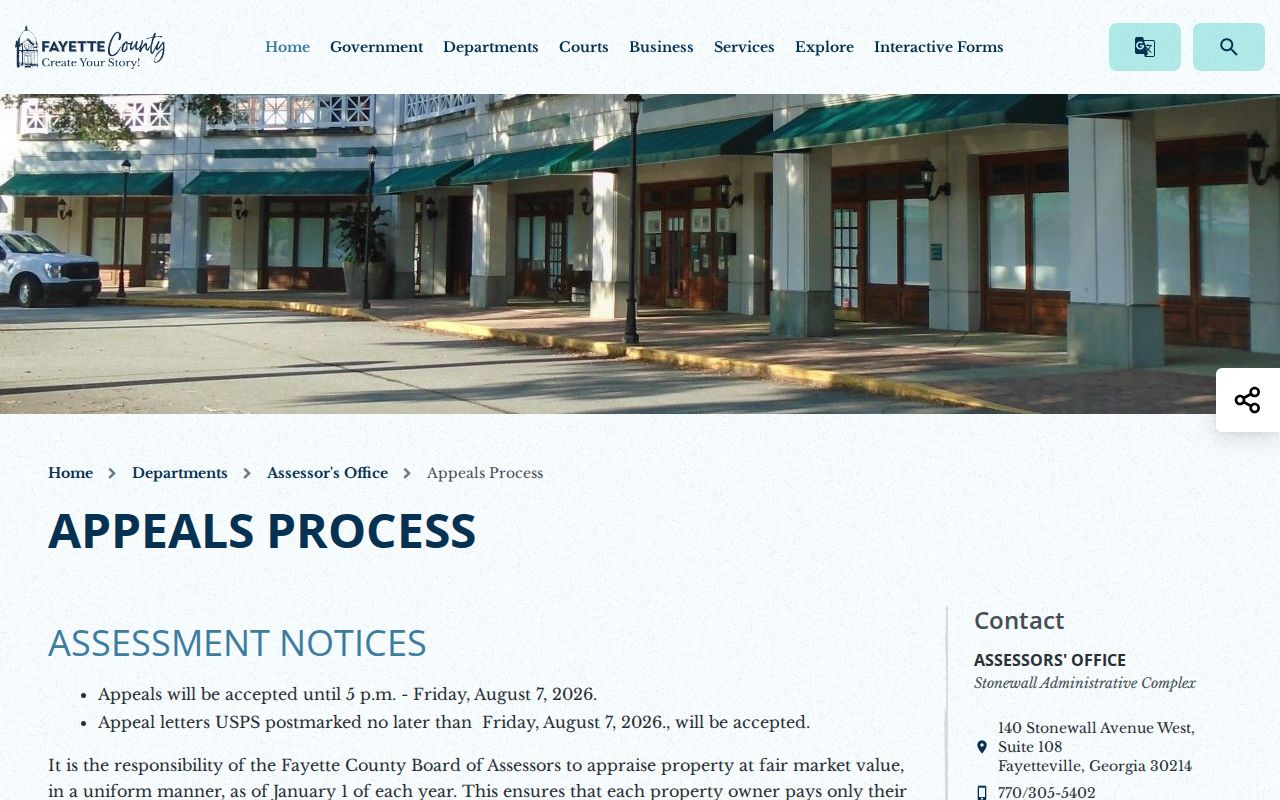
The page describes the process, but the delivered notice controls the 45-day deadline for that Fayette County parcel.
Resolve the date conflict. One official 2026 page displayed July 7 while the appeal page displayed August 7. Use the date printed on the individual notice and confirm it with the Assessor.
The 2026 residential and commercial notices were reported mailed June 23, with value measured as of January 1. Preserve proof of submission and any qPublic confirmation.