
Tracing Fayette County Former Owners
A sound chain works from the newest record toward the oldest. The Fayette County Superior Court Clerk holds the instruments that moved title. The Clerk also holds the indexes pointing to them. For a recent transfer, the live Fayette land-record search is the fastest opening move. A name or instrument may fail to appear in the modern results. Then the Clerk's old-book finding aid supplies the off-ramp. Historic plats and tax series then help separate the right tract. They also keep it apart from another parcel held by someone with the same name.
| Source | Years It Covers | Where Held | What It Shows |
|---|---|---|---|
| Live land-record index | Current coverage; earliest online year not stated | Fayette Superior Court Clerk portal | Parties, dates, instrument, book/page and consideration |
| Old Index Books | 1794 to 1903 finding-aid range | Clerk's online old-book selector and custody | Alphabetic grantor and grantee routes |
| Historic deed books | Late 1700s onward in several runs | Superior Court Clerk | Full transfer text and legal descriptions |
| Plats, surveys and tax series | Series-specific; some begin in the 1780s | Clerk finding aid and county archives | Lot identity, tract shape and year-by-year context |
Use the live index for a known recent owner. Use the old books once the chain crosses the portal's unknown starting point. When the wording shifts from a street address to a tract, match district, land lot, acreage, subdivision, lot, block, and plat reference first. Only then accept the next name as a former owner of record.
Fayette County Former Owners in the Deed Index
The live index reports how current its results are. That stamp tells you whether a newly filed deed should already appear. It does not establish how far back the online record reaches. The portal also caps any search at 1,000 individual records. A broad surname can hide the transfer you need inside a truncated set. Narrow by instrument group, date, address, subdivision, book and page, or consideration when known. The index also exposes routes for non-indexed documents and Old Index Books. An empty modern result is not proof a transfer never happened. It is a prompt to change modes. Or ask the Clerk to check the older material. The Fayette land-record search displays the local index choices used to narrow a deed chain.
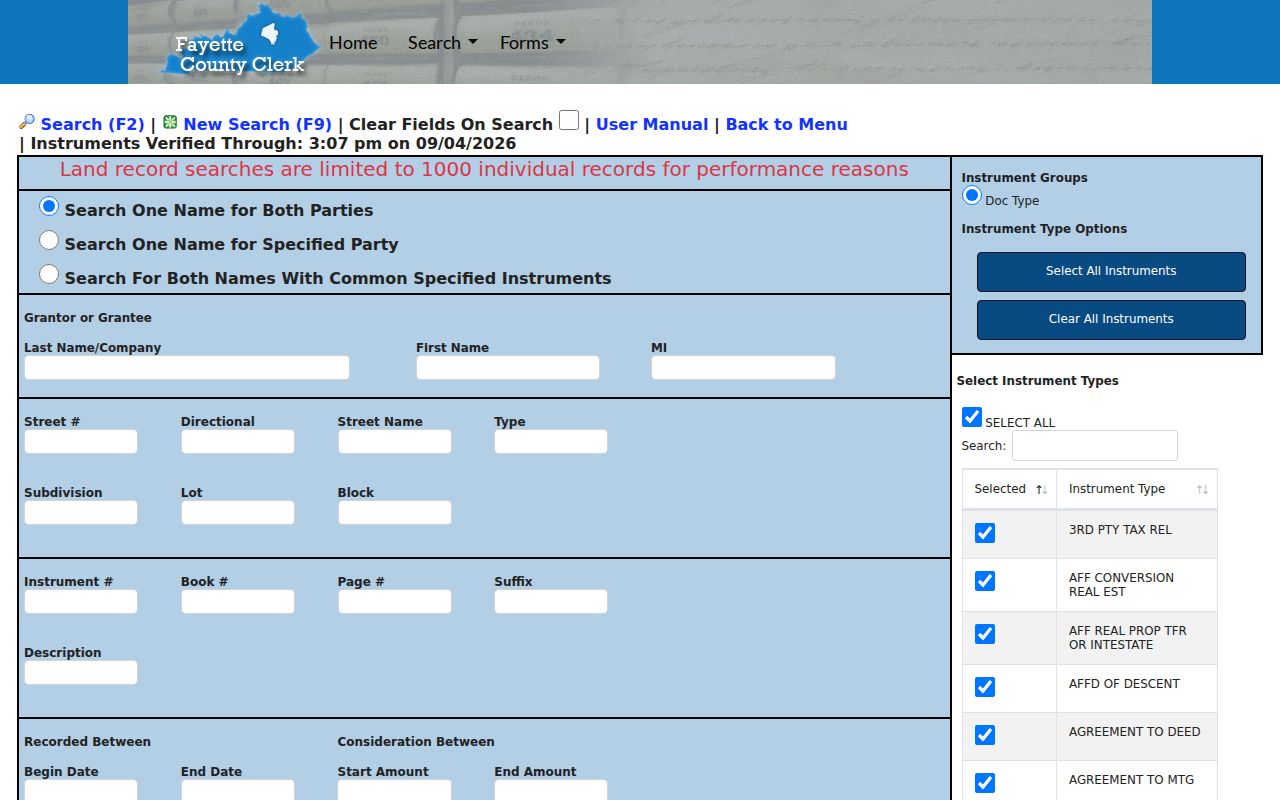
Note: Save the verification status and the selected mode alongside any results you keep.
Note: The research did not establish an earliest live online year, so no cutoff date should be assumed.
Fayette County Former Owners Transfer Timeline
Build a working timeline before opening many images. Each row should stand for one deed touching the same legal parcel. The names move backward. The grantee on one row becomes the person whose earlier acquisition you must find next. Dates alone are not enough. One owner may hold several tracts, and a corrective deed can repeat a transfer without changing beneficial ownership.
| Transfer Date | Grantor to Grantee | Deed Type | Book/Page |
|---|---|---|---|
| Newest recorded date | Prior holder to current grantee | DEED or DEED OF CORR | Copy from index result |
| Earlier acquisition | Earlier holder to that prior holder | Confirm from instrument | Copy exactly |
| Next earlier link | Repeat with the same tract | Watch probate or quitclaim forms | Retain volume citation |
This is an evidence worksheet, not a sample of real owners. Add the legal-description clue beside each row in working notes. A land lot, subdivision lot, or acreage mismatch means the names likely belong to a different Fayette County property.
Reconstructing Fayette County Former Owners Backward
Begin with the current deed, not an old family name. The newest instrument fixes the parcel in one place. It also names the present grantee and the immediate grantor. From there, the grantor-grantee index becomes a backward ladder. Keep the legal description beside the name at every step.
- Find the newest purchase deed with the present holder listed as grantee.
- Read its grantor and confirm the Fayette legal description, not just the street.
- Search that grantor as an earlier grantee and open the acquisition deed.
- Repeat until the live index fails, then continue through Old Index Books and deed volumes.
- Record every instrument number, date, deed type, and book/page citation.
- Grantor / grantee
- The transferring party and receiving party named on a deed.
- Chain of title
- The ordered series of instruments through which ownership passed.
- Reverse index
- An index route organized to find a party on the receiving side of a transfer.
- Warranty / quitclaim
- Different deed forms whose legal effect must be read in the recorded instrument.
- Legal description
- The land-specific text that remains useful when a mailing or street address changes.
Fayette County Former Owners Before the Live Index
The Clerk's old land-record finding aid describes alphabetic index books covering 1794 through 1903. It also maps deed-book runs in more than one numbering scheme. One group covers A through Z and 1 through 149. It reaches from the late 1700s to 1825. Books 1 through 159 begin in October 1825 and extend into 1910. Later series carry the record trail forward. Old handwriting and variant spellings slow the search. Multiple book systems add delay too. It is slower than a modern name search. Search both grantor and grantee sides. Copy the index citation first, then request or inspect the cited deed page. The finding aid carries a "burnt" record-series label. The Clerk's catalog does not confirm a courthouse fire or a specific loss. Treat the label as a catalog term until the office explains it.
Plats Anchor Previous Fayette County Owners
A recorded plat can keep a chain on the right parcel. That matters when old deeds use lot-and-block terms instead of a modern address. Fayette County's subdivision GIS layer carries fields for subdivision name, phase, city, jurisdiction, and final-plat status. Recording details sit there too. The same layer lists plat book and plat page. Treat those fields as discovery aids. The recorded plat held by the Clerk is the document to inspect. Look for the same subdivision, phase, lot, and book/page in each deed. For rural tracts, district, land lot, acreage, and survey references matter more. The Clerk's historic inventory also points to surveys from the 1780s. Survey Book A covers 1817 through 1876. These sources can bridge a current parcel shape. They also clarify the land wording used for past owners. The planned-village names in Peachtree City show why this matters. A current place name may be a useful lead. The plat citation and legal description are the durable links.
Probate Links in Fayette Chains
Not every former-owner change in Fayette County reads like a sale. A death can trigger a will. It can also trigger estate administration, a court order, an administrator's deed, or an executor's deed. So one ownership transition may leave paper in two places. The Fayette Probate Court holds part of it. The Superior Court Clerk may hold the rest. When a clean buyer-seller chain disappears, search the land index instrument list for estate-related roles and document types.
Run separate queries for the decedent, the estate representative, and the later grantee. Then compare the property description between the probate record and the recorded conveyance. Older transfers often surface in historic wills and guardian material. County orders and partition-of-lands records may appear in the Clerk's finding aid. The probate file establishes authority and heirs. The recorded deed shows what actually entered the land records. Together they close the gap.
Inspecting Fayette Records Offline
The online index is only a finding tool. The Clerk's public-inspection policy covers deeds, liens, UCC material, court files, and other records in its custody. Sealed records and some images stay restricted. Missing image? Request inspection at the Clerk's office with the book/page or instrument citation. Mail and counter requests still work when a digital property search stalls.
For historic context beyond the deed books, turn to the Fayette County Historical Society. Local library collections and the Joel Cowan History Room offer more. Directories, newspapers, maps, and planned-community material there can tie a person to a place. None of it replaces the recorded transfer itself. Georgia Archives material offers another route. It serves state and county series that have left active custody.
Pulling a single instrument has its own mechanics. The Fayette County deed records guide covers the details. This page focuses on the full line of previous owners.
How Far Fayette County Former Owner Records Reach
Fayette County was created in 1821. Yet the Clerk's finding aid describes land material reaching into the late 1700s. A seamless online chain back to 1794 is not guaranteed for every modern parcel. County formation, changing book schemes, and probate transfers can force a property search across several record series. Tract subdivisions and older surveys can do the same. The 1825 courthouse, Georgia's oldest still in use, gives this paper trail a striking setting. Still, the catalog and recorded citations matter more than the building story.
Know when to stop. Quit only when the evidence changes jurisdiction or reaches an original grant source. Keep the last Fayette citation. Then follow any land grant, treasury warrant, county order, survey, or predecessor-jurisdiction clue it names. Never fill a break with a likely surname. Historical answers and legal reliance differ. If you need legal reliance, a title professional can confirm the owner of record through the deed records.
Lawful use. Former-owner research supports house history, estate work, and property diligence. Never use living-person details to stalk, harass, or cause harm.