
Begin a Fayette County Search
Start with the Board of Assessors qPublic search. A street address there pulls up the owner of record carried on the assessment roll along with the parcel or map number. That number beats a name alone. Owners often hold several tracts, and mailing addresses rarely match the property address, so the identifier keeps a Fayette County property search from drifting to the wrong lot. The county GIS map then shows whether the parcel boundary sits where you expect.
From there, take the name and legal description to the Clerk's deed records index. Remember the limits. The assessor does not decide legal title. The tax office does not keep deeds. A GIS line is not a survey. Fayette County property records work best as a chain of separate sources, each confirming the next.
- Enter the street address in qPublic and copy the parcel number, roll owner and situs address.
- Search the owner as grantee in the Fayette land-record index, then compare the parcel description.
- Open the latest bill at FayetteCountyPay for tax status and payment history.
- Orient the tract with the official GIS parcel, subdivision and zoning layers.
- Request the recorded image or certified copy from the Clerk when proof is needed.
Fayette County Records Custodians
Three offices anchor the records trail in Fayette County. The Board of Assessors values parcels and maintains the assessment roll. The Tax Commissioner issues and collects the tax bill. The Superior Court Clerk records deeds, mortgages, liens, releases, easements and plats. When a document image is absent online, in-person access fills the gap. The Clerk's public inspection policy provides counter terminals and supervised file review from 9 a.m. to 5 p.m. on weekdays except holidays.
Board of Assessors
140 Stonewall Avenue West, Suite 108
Fayetteville, GA 30214
770-305-5402
Tax Commissioner
140 W. Stonewall Avenue, Suite 110
Fayetteville, GA 30214
770-461-3652
The Parcel Number Connects Records
The parcel number is the common thread through Fayette County property records. On the GIS parcel service it shows up as PARCEL_NO or PARCEL_KEY. Alongside it sit acreage, district, land lot, zoning and review fields. On an assessment notice it appears as the property ID or map number. Same number, different labels.
A deed works differently. It leans on book, page, instrument number and the legal description. Treat the parcel number as orientation, not a substitute for the deed text itself. The GIS also publishes subdivision metadata. That includes place name, phase, city, jurisdiction, final plat, plat book, plat page and recording data. Those fields give you a disciplined route from a modern address back to a recorded plat.
- Parcel number
- A county identifier for a mapped tax parcel.
- Situs address
- The location of the property, which may differ from the owner's mailing address.
- Plat
- A recorded survey drawing that lays out lots, blocks and other features.
- Grantor and grantee
- The party conveying an interest and the party receiving it.
Note: A parcel can be split or combined, so retain the source date and compare older identifiers.
Fayette County Property Record Types
No single search result tells the full story. Pick the record that matches the fact you are testing, then confirm anything important with the office that created it.
| Record Type | What It Documents | Kept By | Access |
|---|---|---|---|
| Deeds | Recorded transfers, parties and legal descriptions | Superior Court Clerk | Index, terminal or copy request |
| Mortgages and liens | Recorded security interests and releases | Superior Court Clerk | Land-record index |
| Assessment and tax | Roll owner, value, exemptions, bill and payment | Assessor and Tax Commissioner | qPublic and FayetteCountyPay |
| Parcels and plats | Mapped geometry, lot, block and subdivision | GIS and Superior Court Clerk | ArcGIS layers and recorded plat |
| Building permits | Issue date, work class, value and land lot | County or municipality | Reports or local portal |
Follow recorded ownership through Fayette County deed records. For assessments and bills, take the property tax records route, and see the parcel maps page for geometry and plats.
Fayette Deeds and Index Limits
The live land index accepts searches by party and street. It also covers subdivision, lot, block, instrument, book/page, date and consideration. The index groups instruments in several ways. Deeds, mortgages, liens, leases, plats, releases, powers of attorney and wills each get their own category. Broad searches stop at 1,000 records. So narrow a common name first. Filter by party role or instrument type. You can also filter by date, street or subdivision before deciding a record is missing. The portal displays instruments verified through 3:07 p.m. on September 4, 2026. That timestamp tracks indexing progress, not the legal force of each result. Non-indexed documents and the Old Index Books are separate routes entirely. The live Fayette deed search shows the current fields and verification line.
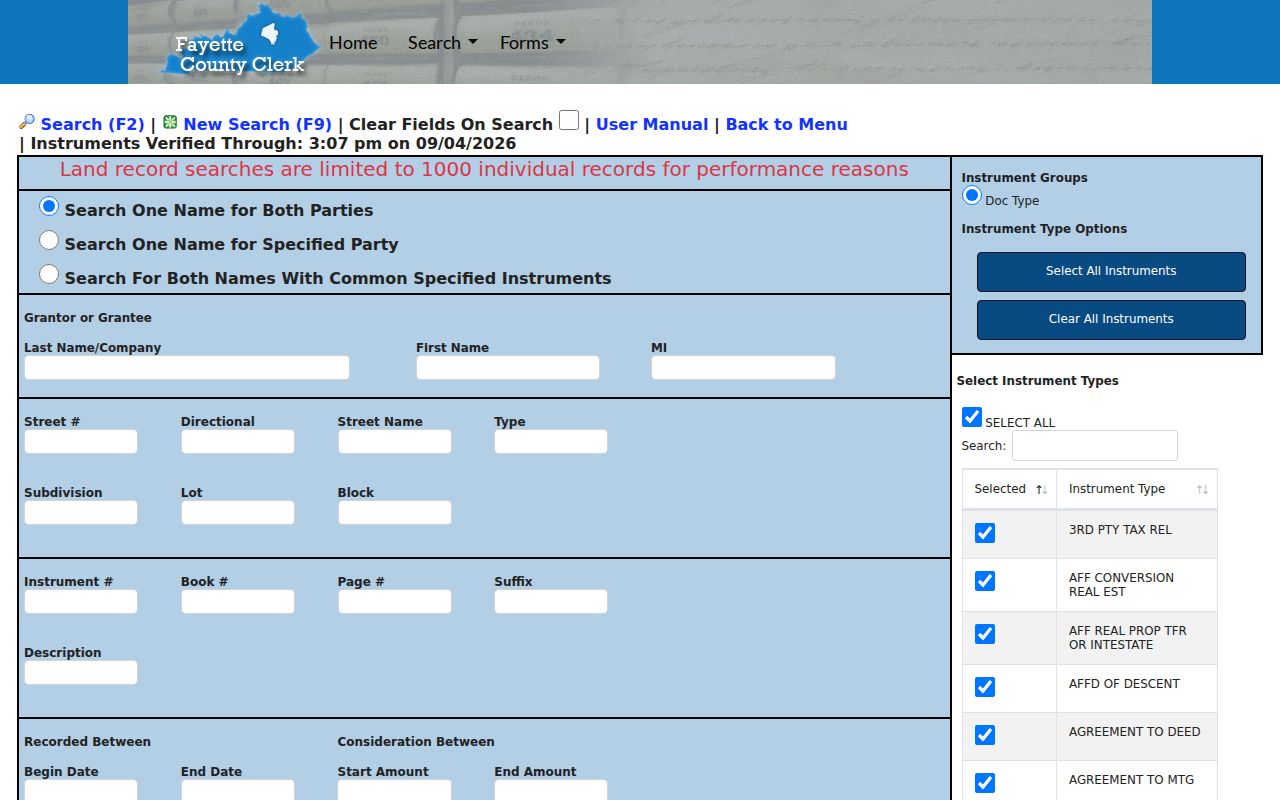
The live search pairs party roles with legal-description fields and instrument filters. That layout rewards a narrow, repeatable query over one broad surname sweep.
Historic Fayette Land Books
Fayette's paper trail runs far deeper than its modern portals. The Clerk's Old Index Books finding aid catalogs deed and mortgage indexes generally spanning 1794 through 1903. The aid also lists old deed books, surveys from the 1780s and 1817 onward, partition records, county orders, wills, and property tax series for 1807 and 1808. Some entries overlap or sit out of order in the older PDF. Ask staff to confirm a boundary year before you rely on it.
Begin with a modern legal description. Work the latest deed backward. When the web trail ends, the old index books, counter terminals, and physical volumes take over. Georgia Archives guidance keeps county records with the county. The Fayette County Historical Society and library resources add family and place context. Still, no narrative replaces a recorded instrument.
Maps, Plats and Fayette Geography
The Fayette GIS service directory exposes parcel, subdivision, zoning, road, utility and other public layers. Use it to test whether an address falls in unincorporated Fayette County or inside Fayetteville, Peachtree City, Tyrone, Brooks or Woolsey. That distinction matters. It controls which planning office may hold a zoning or permit file. Planned-village and subdivision names can sharpen a search too. Peachtree City's Aberdeen, Braelinn, Glenloch, Kedron and Wilksmoor history offers especially useful labels. But a name alone is not a city assignment. Confirm the GIS City and Jurisdiction fields. Then match FinalPlat, PlatBook and PlatPage to the Clerk's recorded plat.
Fayette Assessments and Tax Bills
The assessor values property as of January 1 and separates the 100 percent fair market value from Georgia's 40 percent assessed value. An assessment notice may show the owner and mailing address, property ID, situs address, acreage, tax district, homestead or covenant status, prior and current values, reason for change and estimated tax. The Board of Assessors sets value; the Tax Commissioner creates the bill.
Official 2026 pages showed conflicting appeal dates. The assessor index listed July 7 after notices mailed June 23, while the separate appeals page listed August 7 at 5 p.m. The controlling date should be taken from the parcel's own notice and confirmed with the assessor. Written appeals have a 45-day framework and may elect Board of Equalization, hearing-officer or arbitration routes when eligible.
Permits Follow Local Jurisdiction
County Building Safety posts permit reports covering 2020 through 2026. The 2026 file updates weekly, with a final version each month. A single line can carry the address, permit number, issue date, class, and square footage. It also holds the valuation, district, and land lot. Those last two fields are quiet workhorses. They tie a recent project back to older deeds, surveys and plat records. Municipal land-use files live in separate systems. Fayetteville relies on BS&A Online and a tiered zoning-letter request. Peachtree City, in turn, publishes development applications. Tyrone routes permits through Community Core. Brooks takes complete applications in person or by mail. It then forwards approved building material to the county. Check the City and Jurisdiction field in the GIS map. That step settles the custodian question before you start a property search.
Fayette Property Fraud Alerts
The Clerk's office provides PropertyCheck and FANS information so owners get alerts when new activity records against their Fayette County property. Think of an alert as an early warning. It proves nothing and blocks nothing. When a notice arrives, compare it against the Clerk's deed index and call the recording office through its official number; the county's fraud-alert page lays out both the county and statewide alert options.
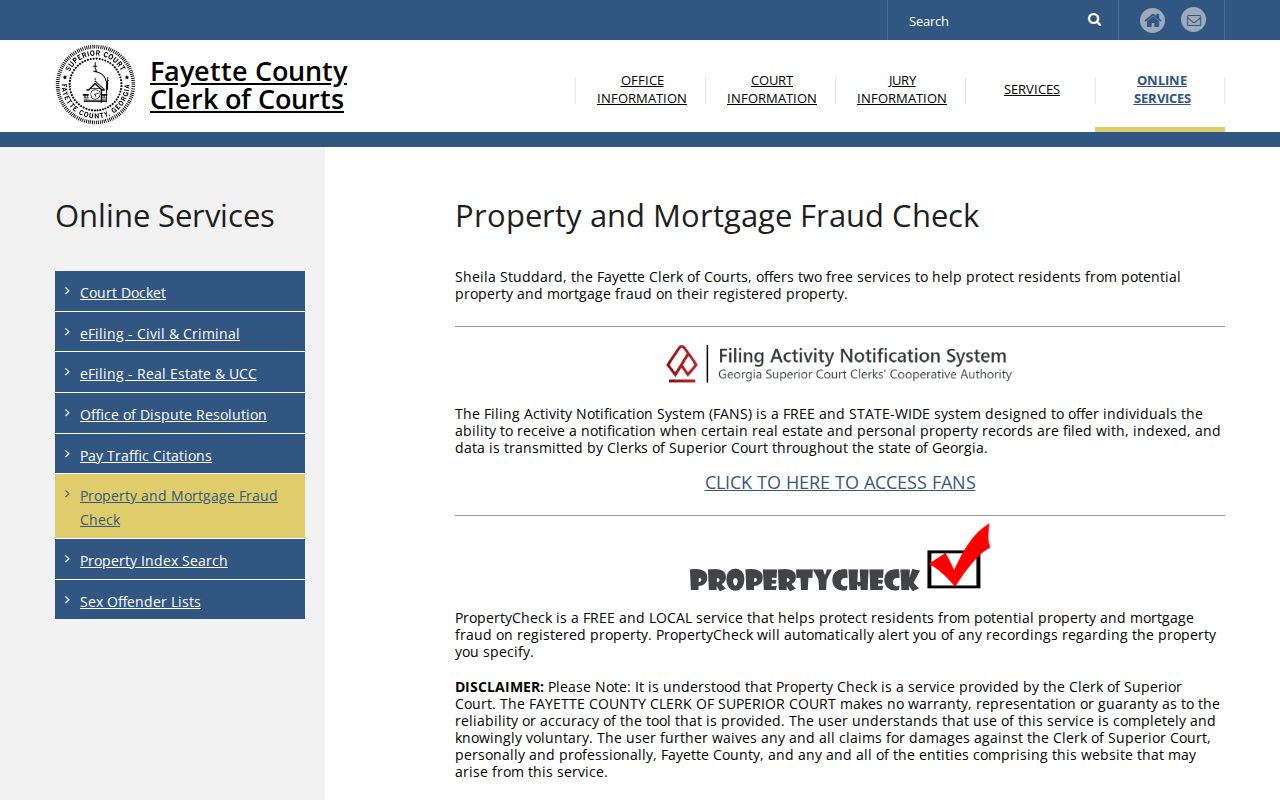
Fraud alerts are built for speed. They help an owner spot a suspicious filing within days rather than months, but a certified copy from the recorder remains the authoritative record of any instrument.
When Fayette Portals Fall Short
An empty search result is not a dead end. Fayette County's deed system holds non-indexed documents. Old books sit there too, and the web index never reaches them. qPublic access can fail without warning. The tax system may demand a CAPTCHA. Municipal portals sometimes sit behind an account login. Write down the address, parcel number, record type and date span before contacting the custodian. A specific citation gets a faster answer than a vague one. Georgia's Open Records Act, O.C.G.A. §50-18-70 et seq., opens a formal request route to existing public records. It stays subject to exemptions, fees and redaction. Ask for a defined file rather than an open-ended search. When material stays offline, the fallback chain runs from Clerk terminals to mail or email requests. The chain then widens to the library, the Historical Society and the Georgia Archives.
Limits of Fayette Property Records
Fayette County property records answer many questions but not all of them. The tax roll shows the assessment-roll owner, recorded conveyances, stated consideration and tax status. It also covers exemptions, permit events and mapped context. What they cannot do is guarantee clear title. They will not resolve every easement. Nor will they establish a surveyed boundary or substitute for a current sale appraisal. LLC, trust and estate owners add another wrinkle. Business or probate records may be needed to pin down who truly holds each party's role.
Lawful use. Use Georgia records for legitimate property research and civic transparency. A lookup does not replace a title professional or licensed surveyor, and owner data must never be used to stalk, harass or harm anyone.
Fayette Records Beyond the Portal
The portal is one channel among several. The Superior Court Clerk allows public inspection of deeds, liens, UCC filings and other non-court records. Statutory exemptions still apply. Public terminals reach more proceedings and images than the web index does. Actual files are reviewed under staff supervision. Inspection hours run Monday through Friday, 9 a.m. to 5 p.m., except holidays. Bring the instrument number or book and page if you have it. That citation alone can save real search time. A missing online image can still be ordered. The Clerk's fee schedule, dated July 2024, lists unassisted standard copies at $0.50 per page. Assisted copies cost $1 per page. Certification adds $0.50 per page plus a $2.50 seal. Large-format pages and electronic delivery carry separate rates. Fees change, so confirm the total and the required delivery method before ordering. Sometimes a county department identifies a public file but offers no search box for it. In that case, file a focused request under the Georgia Open Records Act. The statute is O.C.G.A. §50-18-70 et seq. Name the parcel ID, property address, record type, department and date range. Georgia agencies generally answer within three business days. Otherwise they state when responsive records will be available. That timeline is not a promise. Every requested item may not be open or ready on demand.
Fayette Estate Property Trails
Not every change of ownership reads like a sale. A death can start a transfer instead. Fayette Probate Court oversees wills, estate administration, guardianships, and conservatorships. Its online page supports a file-name search. Inside an estate file you may find petitions, inventories, annual returns, and heir details. You may also find the authority granted to an executor or administrator to sell land. Those papers establish who could act. A later deed in the Clerk's land records documents the recorded conveyance.
Names open different doors. Search each one separately: the decedent, the estate itself, and the executor or administrator. The deed index includes WILL entries along with miscellaneous and order categories. Check those too. Compare dates, party roles, and the full legal description. Probate and land records can label the same transfer differently. Certified death records follow Georgia eligibility and closure rules. Request them only when you qualify.
Older estates live in the Clerk's book series. The finding aid covers wills from 1793 through 1935, guardians books, and county-order material. Such records can bridge a break in a deed chain. Still, tie every reference to the same tract. Use a land lot, survey, subdivision, lot, or book-and-page citation.
Property Courts in Fayette County
Some land fights never touch the deed portals. Foreclosure proceedings, quiet-title actions, lien disputes, boundary claims, and partition cases land in Superior, State, or Magistrate Court records depending on jurisdiction. The Fayette Clerk posts local docket access links. Statewide, PeachCourt offers another provider route. Search by party name, case number when known, court, and filing dates.
Record the case number, party roles, case type, docket events, disposition, and document availability. A complaint is only an allegation. A lis pendens in the deed index flags pending litigation over land, while the court docket carries the procedural history. Read later releases, dismissals, and orders before assuming current status.
Tax distress follows a separate route. The Tax Commissioner tax-sale page is the official starting point. It publishes no current sale list or date. Never rely on an old notice. Confirm the parcel list, sale schedule, payment method, and redemption terms with the office directly.
Privacy in Fayette Property Research
Open records do not cancel privacy protections. Georgia Safe at Home, launched in 2026, gives eligible survivors and at-risk people an address-confidentiality option. VoteSafe separately shields qualifying voter-address information. A substituted or withheld address is a legal safeguard, not a data glitch to defeat by merging unrelated sources.
Keep searches tied to a real property purpose. Purchase research, estate work, boundary questions, and public accountability all qualify. Do not republish personal mailing details without need. Each office corrects its own records. When a public record looks wrong, send the fix to its custodian: the assessor for a roll field, the Tax Commissioner for billing data, the Clerk for an indexed instrument, and the planning office for land-use files.